Arctic Story House
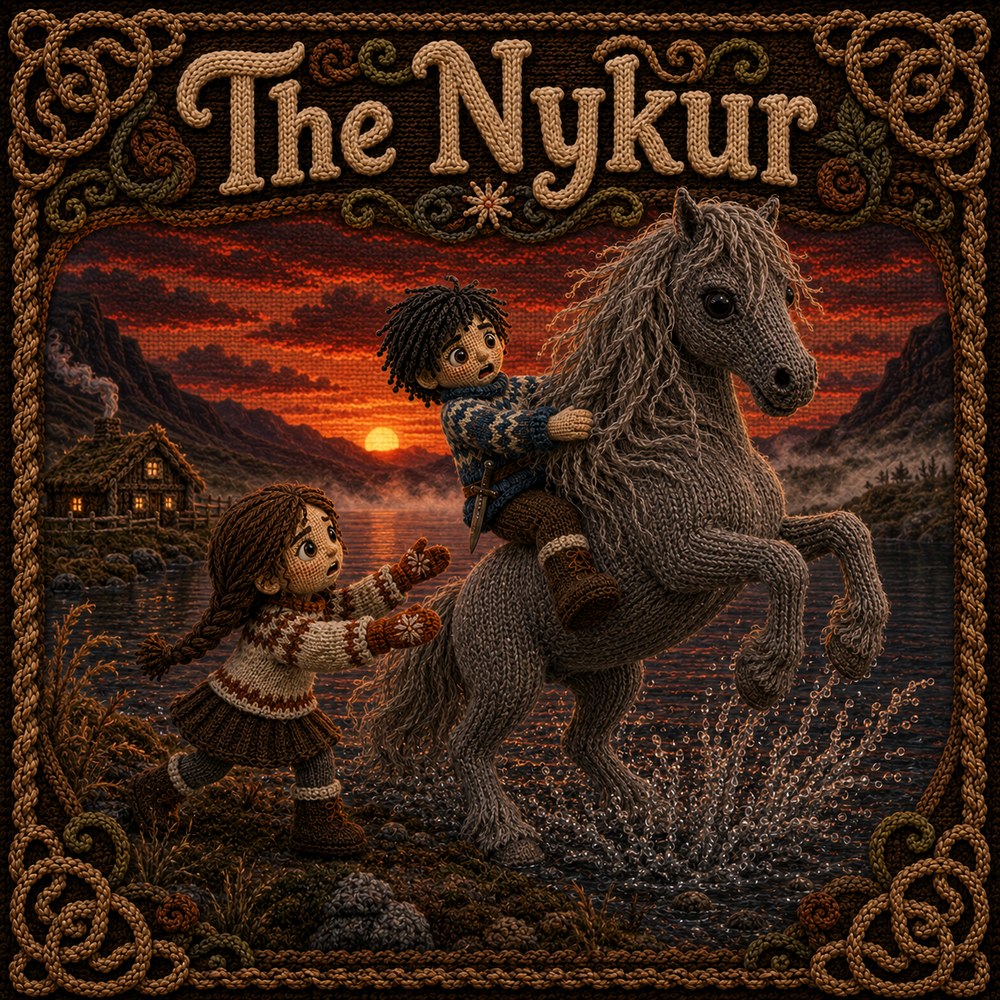
The Nykur
Once there was a farm by a lake, deep in the countryside, where evening mist settled over the banks before the sun had quite set. The lake was deep and dark. On good days it mirrored the sky, but on bad days it was black, as if it had no bottom at all.
Two siblings lived on the farm, a boy and a girl. He was called Ari, she was called Una. They had often been warned about the lake.
"Don't go too near the bank when the mist comes," their mother said. "And if you see a beautiful grey horse by the water, don't touch it."
"Why not?" asked Ari.
"Because some horses aren't horses," their mother answered.
Una remembered these words. Ari remembered them too, but he was the sort who always wanted to see for himself what others told him to avoid.
One late-summer evening the siblings went to fetch lambs that had strayed down toward the lake. The sun hung red behind the mountain, and the air was so still they could hear their own footsteps in the grass. They found the lambs quickly, but as they turned to go home, they saw a horse on the bank.
It was pale grey, with a mane that fell down its neck like a thread of silver. It stood still and looked at them. No bridle was on it, no iron beneath its hooves. It was so beautiful that Ari forgot the warning at once.
"Look," he whispered. "It's like something from a dream."
Una gripped his sleeve. "Mother said we shouldn't touch a grey horse by the water."
"It's just a horse," said Ari. "Maybe it's strayed from a farm."
The horse took a step nearer. It lowered its head, as if inviting them onto its back.
Ari walked toward it. "Don't," said Una.
Ari reached out and touched its mane.
In that instant his hand stuck fast.
He tried to pull it back but could not. "Una," he said, and now the voice was no longer brave. "I can't get free."
The horse turned its head slowly. Its eyes were not a horse's eyes. They were wet and cold, and in them lay a deep, watery night.
Una understood then. This was the nykur.
She grabbed her brother and pulled, but when she touched him, she too stuck fast. The nykur set off, first slowly, then faster, down toward the lake.
The lambs bleated and ran off. Mist rose from the lake like white hands.
Ari tried to kick at the ground. Una did not cry. She looked around, searching for anything at all. Then she saw a small iron knife in Ari's belt. Their father had given it to him to cut twine.
"The knife!" she called.
Ari tried to reach it with his free hand, but the horse shook itself and they were flung about. The water was now only a few steps ahead.
Una stretched down. Her fingers touched the handle. She drew the knife up, and with all the calm she had left, she cut through her sleeve where it had stuck to Ari's.
She came free.
But Ari was still fastened to the nykur. Una fell into the grass. The nykur leapt forward. Water splashed beneath its hooves.
"Ari!" she cried.
Then she remembered the words of an old woman who had once lived on the farm: Everything that comes from water bears its true name badly, if it is spoken with faith.
Una rose to her feet, drew a deep breath, and called as loudly as she could: "Nykur! Nykur! Nykur!"
The horse whinnied, but the whinny turned into a horrible shriek. It jerked as though the word had burned it. Ari fell from its back and landed in the shallow water at the bank.
Una ran to him, grabbed his collar, and dragged him up onto land.
The nykur retreated into the lake. It was no longer beautiful. Its mane became water-weed, its hooves black rocks, and its eyes vanished beneath the surface. Only ripples on the water showed where it had been.
The siblings ran home with the lambs following, wet, shivering, and silent.
Their mother said nothing at first. She brought them in, wrapped them in wool blankets, and gave them hot milk. Then she sat beside them.
"Now you know," she said quietly, "that not every pretty invitation is a good one."
After that, Ari never again went alone to the lake. Una became the one everyone asked when children wanted to know whether the nykur was real.
She never answered directly. She only looked toward the lake, where the mist sometimes rose in the evenings.
"If you see a grey horse where no horse should be," she said, "walk home without touching it."
And sometimes, when there was no wind and the lake lay smooth as glass, a whinny could be heard far out on the deep — one that was not quite a whinny.