 Arctic Story House
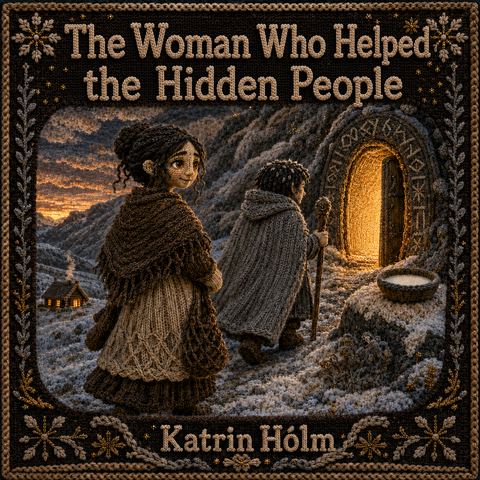
The Woman Who Helped the Hidden Folk
Once there lived a woman on a small farm in a district of narrow home-fields and steep slopes. Her name was Þóra. She was neither rich nor of high standing, but she was known for refusing no one help, even when she had little herself.
On winter evenings, when the north wind swept the valley and snow filled footprints as soon as they were made, Þóra sat by the fire spinning wool. She had one son, young and frail, and one old ewe that gave them milk when years were good. It was not much, but they made do.
One night, when every farm in the district was shut up and no one would go out without cause, there came a knock at the door.
Þóra set down her spindle and listened. The knock came again, gently — not like one who demands entry, but like one who asks for mercy.
She opened the door.
Outside stood a man in a grey cloak. He was pale, with dark eyes and snow in his hair, though the snow did not seem to melt on him. He bowed his head.
"Good woman," he said. "My wife lies ill. Our child is coming tonight, and no help is near. Will you come with me?"
Þóra looked out into the darkness. The weather was bad, the way uncertain.
"Where do you live?" she asked.
The man pointed up the slope, where there was nothing but rocks and snowdrifts.
Þóra understood then that this was no ordinary man.
Her son woke and called weakly: "Mother, don't go."
Þóra went to him, drew the blanket over him, and kissed his forehead. "Sometimes help comes home again to the one who gives it," she said.
She wrapped a shawl about herself, put a piece of bread in her pocket, and followed the man out into the night.
They climbed the slope. The snow reached Þóra's calves, but the man walked lightly, as if he scarcely touched the ground. At last they came to a great stone Þóra had often seen from the home-field. The man laid his hand upon it, and the stone opened like a door.
Inside was no dark cave, but a warm house. The walls glittered as though light were hidden in the rock. There on a bed lay a woman, pale and weary, and around her stood elf-women with worry in their eyes.
"She has come," said the man.
Þóra set to work at once. She asked for water, clean cloths, and light. She spoke gently to the woman, held her hand, and let no one grow afraid. The night was long, but before it ended a child was born, small and living, with hair as soft as cotton-grass in the bog.
The hidden folk breathed easier. The mother smiled weakly. "You have done us great good," she said.
The man brought Þóra a small box. "Take this for your help."
Þóra opened it. Inside was a gold ring, bright and fine.
She closed it again and shook her head. "I didn't come for gold," she said. "Give it to your child later."
The hidden folk looked at one another, astonished. Then the mother took a small bottle from beneath her pillow.
"Take this instead," she said. "Not as payment, but as a blessing. Rub one drop on your son's forehead when you come home."
Þóra took the bottle and thanked her.
Before she left, she was offered food. On the table were bread, butter, fish, and milk. She was hungry after the night, but she remembered old stories. One who eats too much in the dwellings of the hidden folk might forget the way home.
She took only one bite of bread and a sip of milk.
"I have a child at home," she said.
The man led her back to the door in the stone. When she stepped out, morning had come. The snow had stopped, and the sky was pale pink over the mountains.
Þóra ran home as fast as she could. Her son lay in bed, hot and pale. She took the bottle, let one drop fall on her finger, and stroked it over his forehead.
The boy breathed deeply. Then he slept.
When he woke that evening, the fever was gone. In the days that followed he grew stronger. By spring he ran about the home-field like other children, and Þóra wept quietly when no one saw.
At her farm there was never quite a lack of food after that. Sometimes she found a sack of meal by the door. Sometimes fresh fish lay on a stone by the brook. Sometimes the old ewe gave more than anyone could account for.
Þóra told few what had happened. But when people asked why she always set a small bowl of milk by the great stone on the hillside, she answered: "It's good to remember those who remember you."
And for many years after, people sometimes saw a light in the stone on winter nights, soft and golden, as though a small child were still sleeping there in peace.