 Arctic Story House
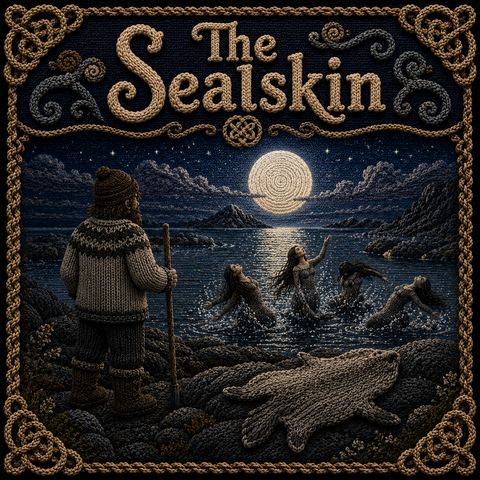
The Seal Skin
Once there lived a young farmer by the sea, on a farm where the home-fields ended in black beach sand and the surf was constant in men's ears. He was a lonely man. He had sheep, a boat, and a house, but no one waited for him inside when he came home from fishing.
Near the farm was a skerry that was clearly seen only when the tide ran low. It was said that seals came there at night, not only ordinary seals but seal-women and seal-men who laid off their skins and danced in the moonlight like people of the sea.
The farmer had heard these tales since childhood. He had not believed them, but he had also never walked to the skerry on the right night.
One Midsummer's night, when the sea was smooth and the moon was full, he woke to singing. He rose from bed, went out, and down to the beach. There he saw light over the skerry, not fire and not sun, but a silver glow lying over everything.
On the skerry women were dancing. At their feet lay sealskins, dark and glossy as wet hide. The women laughed softly, sang, and turned barefoot on the cold rock. One of them was loveliest. Her hair fell down over her shoulders, and her eyes looked sometimes out to sea, even as she danced.
The farmer stood a long while in the shadow of the crag.
Then he saw her skin lying nearest the shore.
He knew he ought to turn back.
But the loneliness in him was old and heavy. He crept forward, took the skin, and hid it beneath his cloak.
When the red dawn came into the sky, the women ran to their skins, put them on, and became seals sliding out into the sea. But the loveliest one searched and searched, and could not find her skin.
She stood alone on the skerry as the sea began to rise.
The farmer stepped forward. "Come with me," he said. "You cannot stay here."
She looked at him and knew at once what he had done.
"Give me my skin," she said.
He did not answer.
She did not ask again. She walked with him to land, silent and pale, and became his wife.
The years passed.
She was a good wife. She worked on the farm, spun wool, baked bread, and had children. The children loved her, for she sang them strange songs no one else knew, songs that sounded like surf in sleep.
But she was never quite home.
In the evenings, when the others slept, she sometimes sat by the window looking out to sea. When seals came up out of the water below the farm, she laid her hand on the pane, and tears ran silently down her cheeks.
The farmer kept the sealskin in a chest. The chest was locked, and he carried the key always with him. He told himself he did this out of love. But love that needs a locked key is not peace.
One day he went to church with his family. His wife stayed home, for the youngest child was ill. When the farmer was halfway there, he felt at his belt.
The key was not there.
He went white as ash. He hurried home as fast as he could, but when he came to the farm, the chest stood open.
His wife was down on the beach.
She held her skin.
The children stood beside her, weeping.
"Mother, don't go," said the eldest child.
The seal-wife knelt and embraced them all. She kissed them on the forehead, one after another.
"I love you," she said. "But the sea called to me before I learned your names, and it has never stopped."
The farmer came running down to the beach. "Stay," he said. "I beg you."
She looked at him a long while. In her eyes was sorrow, but not anger.
"You should have asked me before you took the skin," she said.
Then she put on the sealskin. Her body changed softly, as water flows over stone. Where the woman had stood, there now lay a seal, dark and beautiful. It looked once at the children, once at the farmer, and slipped away into the sea.
The children grew up on the farm. They sometimes saw their mother in the surf. When they walked to the sea alone, a seal would come close to shore and follow them, as though it watched over them. When storms came and boats were in danger, people said a seal swam before the bow and showed them the right way.
The farmer was never the same man again. He did not marry again. He often walked down to the beach and looked at the skerry where the moon lay on the rocks.
Some say he wept there. Some say he asked forgiveness each time the sea fell back at his feet.
But the seal-wife never came up onto land again.
And even today, when the moon is full and the sea lies smooth, people say a song can be heard out by the skerry. It is beautiful, but not joyful.
It is the song of those who love two homes, and can only live in one.